Making housing rights understandable

Clarifying legal obligations for Emotional Support Animals
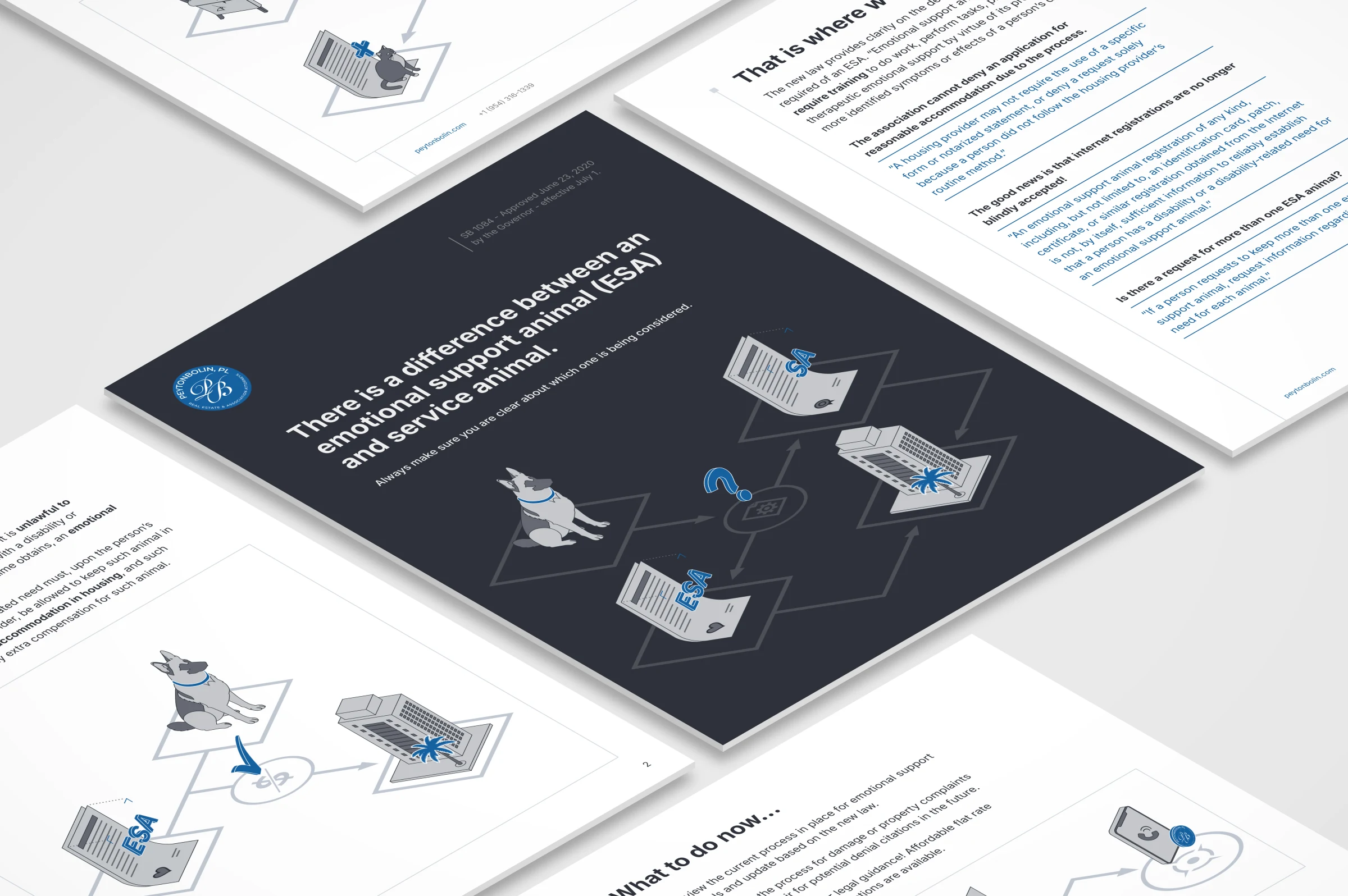
Legal infographic explaining the difference between emotional support animals and service animals through a structured visual process

Category:

Legal Guide

Service:

Visualization

Industry:

Legal Services

Audience:

Housing Providers

Client

PeytonBolin is a Florida based law firm focused on real estate and community association (Condo & HOA) law. Established in 2008, the firm works with homeowners, boards, and property managers on matters related to property transactions, governance, and dispute resolution.
Challenges

Context

In rental housing scenarios involving Emotional Support Animals (ESA), legal responsibilities are often unclear for both parties, particularly for housing providers.

Initial Limitations

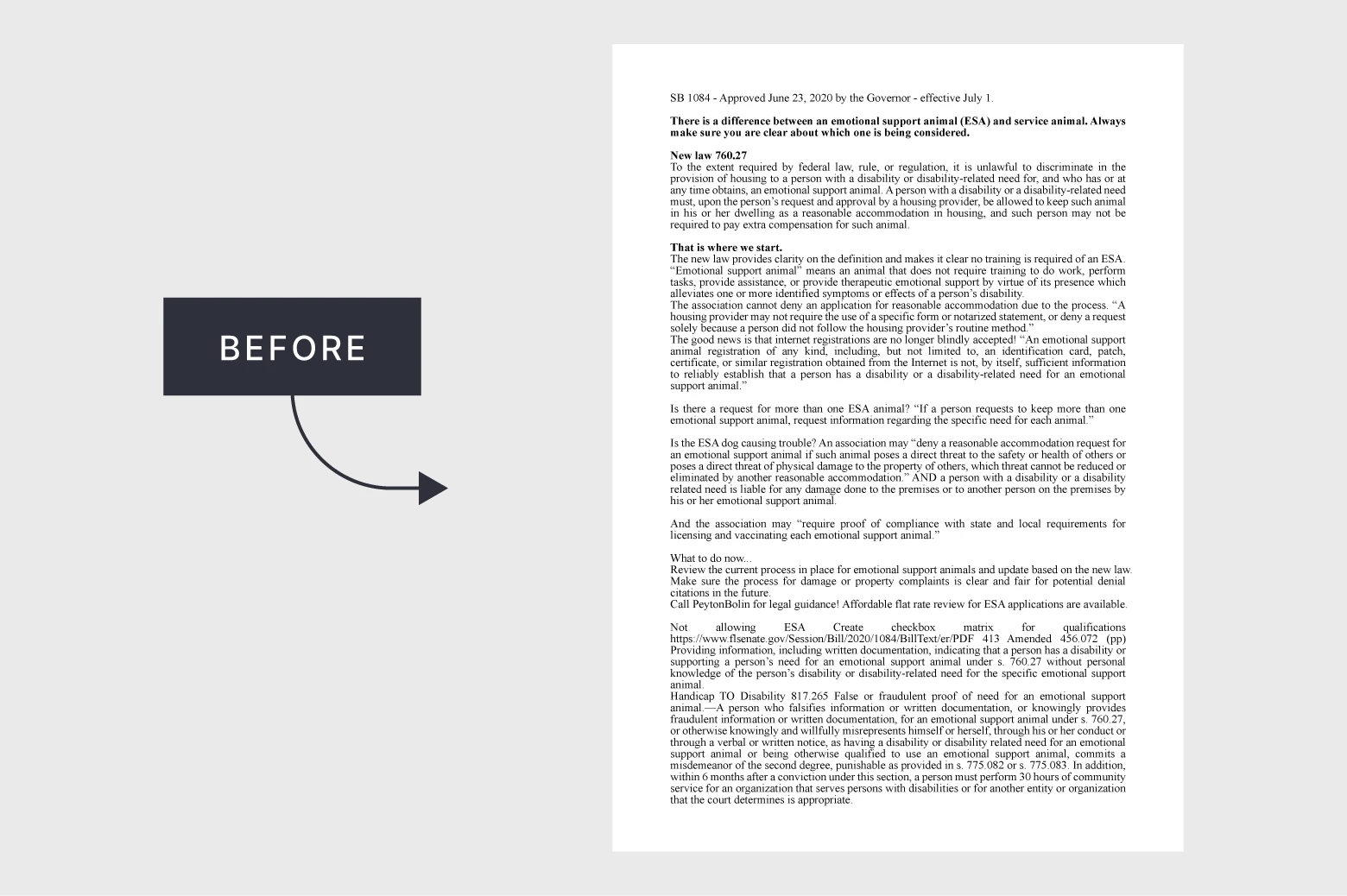
PeytonBolin identified a need to present this legal information in a clearer and more practical format. They prepared a text based document addressing the issue. While the source material was solid, it was too extensive for a one page informational piece and lacked a clear structure. An additional challenge was aligning the tone and style of the new guide with the firm’s existing brand. The website and broader brand assets featured complex and inconsistent typography, minimal visual hierarchy, and no clearly defined visual tone, making them a challenging starting point for establishing visual direction.

Unstructured legal text document before visual simplification and information design

Project Goals

Together, these factors created a multifaceted design challenge: simplifying legal language, reducing text density, establishing a usable structure, and building a visual system that supports clarity while remaining consistent with PeytonBolin’s identity.

Approach

Content Strategy

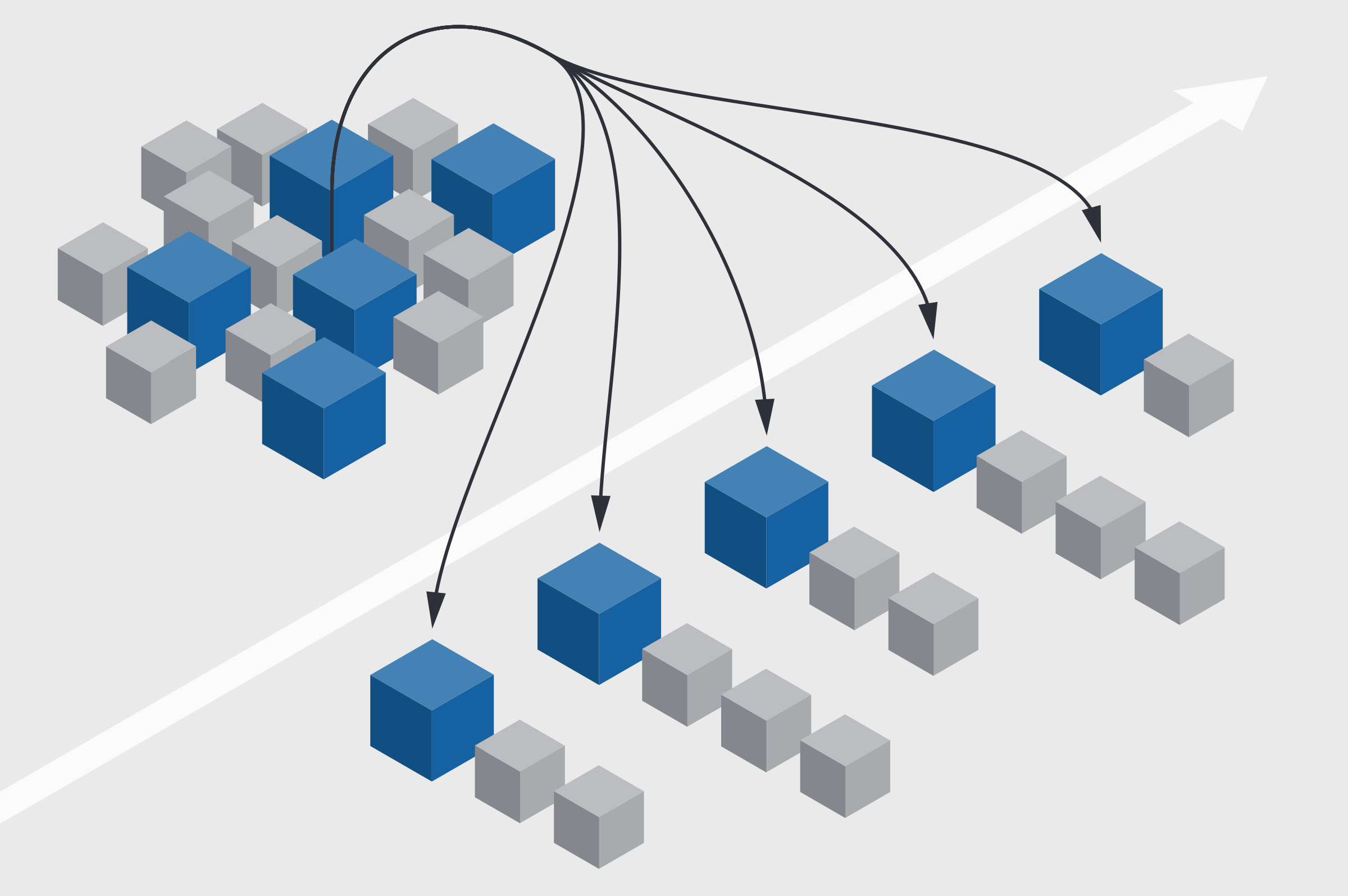
The process began with an analysis of the content and the identification of key issues that could be unclear to housing providers. To improve readability, the original text was expanded across several pages and reorganized into a three main sections, based on the ideas expressed in the source material. Visual explanations were added in the form of illustrations based on different scenarios, helping to convey the key points in a more accessible way.

Visual representation of breaking down complex information into structured and organized components

Visual Language

An isometric style of illustrations was used to effectively visualize the specific issues. A flat style with thin lines for details was chosen to correspond with the firm’s logo. Typography was simplified to a single font to establish hierarchy and improve scannability, compensating for the lack of a clear typographic structure in the firm’s previous brand assets. The color palette was kept limited and restrained, in line with the legal nature of the document. The illustrations were carefully considered in relation to the geographic context; for example, the depicted animal is a German Shepherd, the most commonly used breed as an Emotional Support Animal in Florida.

Impact

Clarity

The revised guide transformed the raw content into a structured and accessible resource tailored for housing providers. Clear sectioning, illustrations based on scenarios, and simplified typography improved readability and comprehension, reducing the cognitive load for non-lawyers.

Consistency

By aligning the visual style with PeytonBolin’s identity while introducing targeted improvements, the guide communicates its content with authority.

Usability

The result is a resource that can be quickly understood, easily shared, and confidently used in housing situations involving ESA.

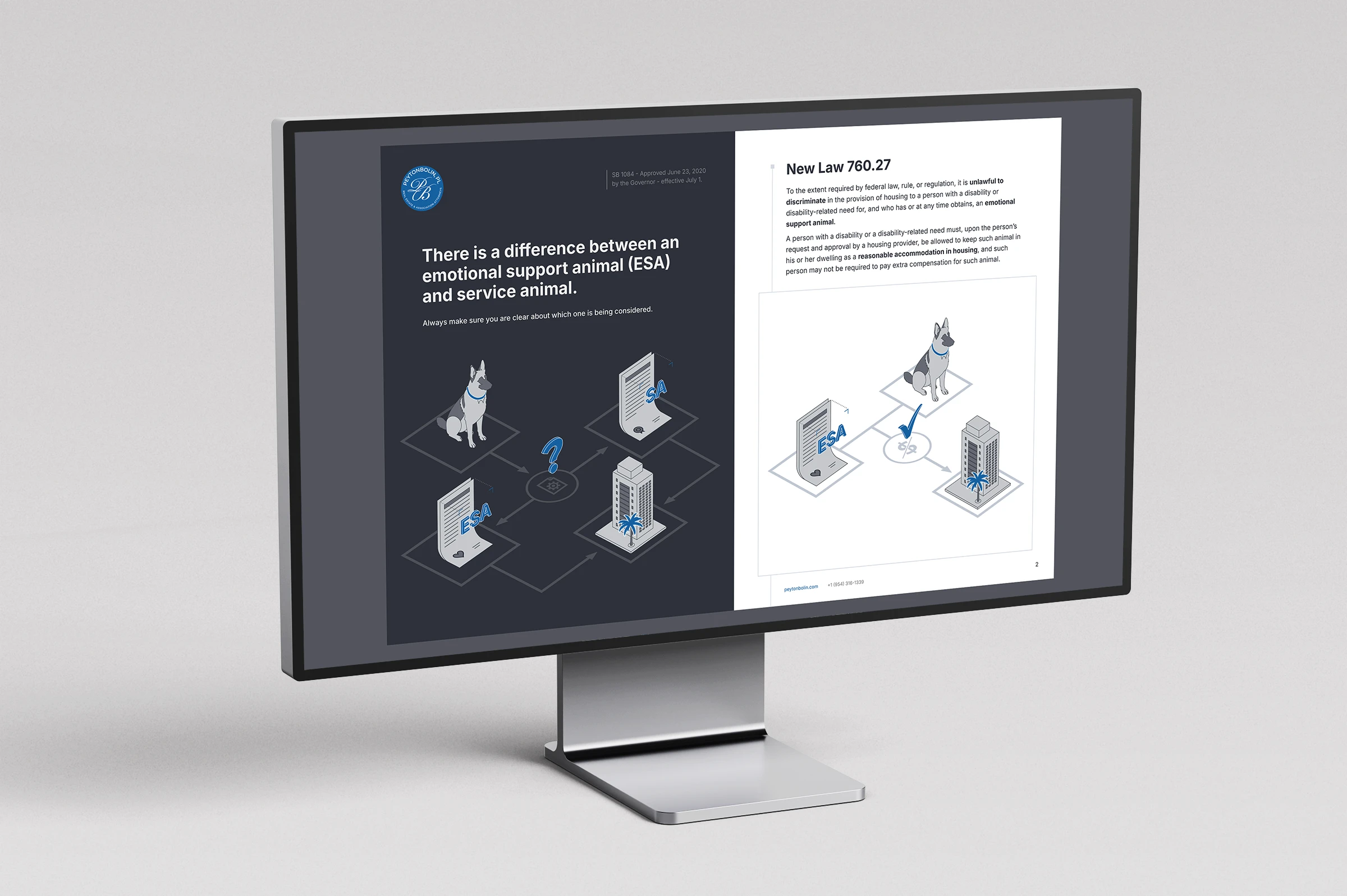
Final legal infographic displayed in a digital format showing structured and accessible housing rights information
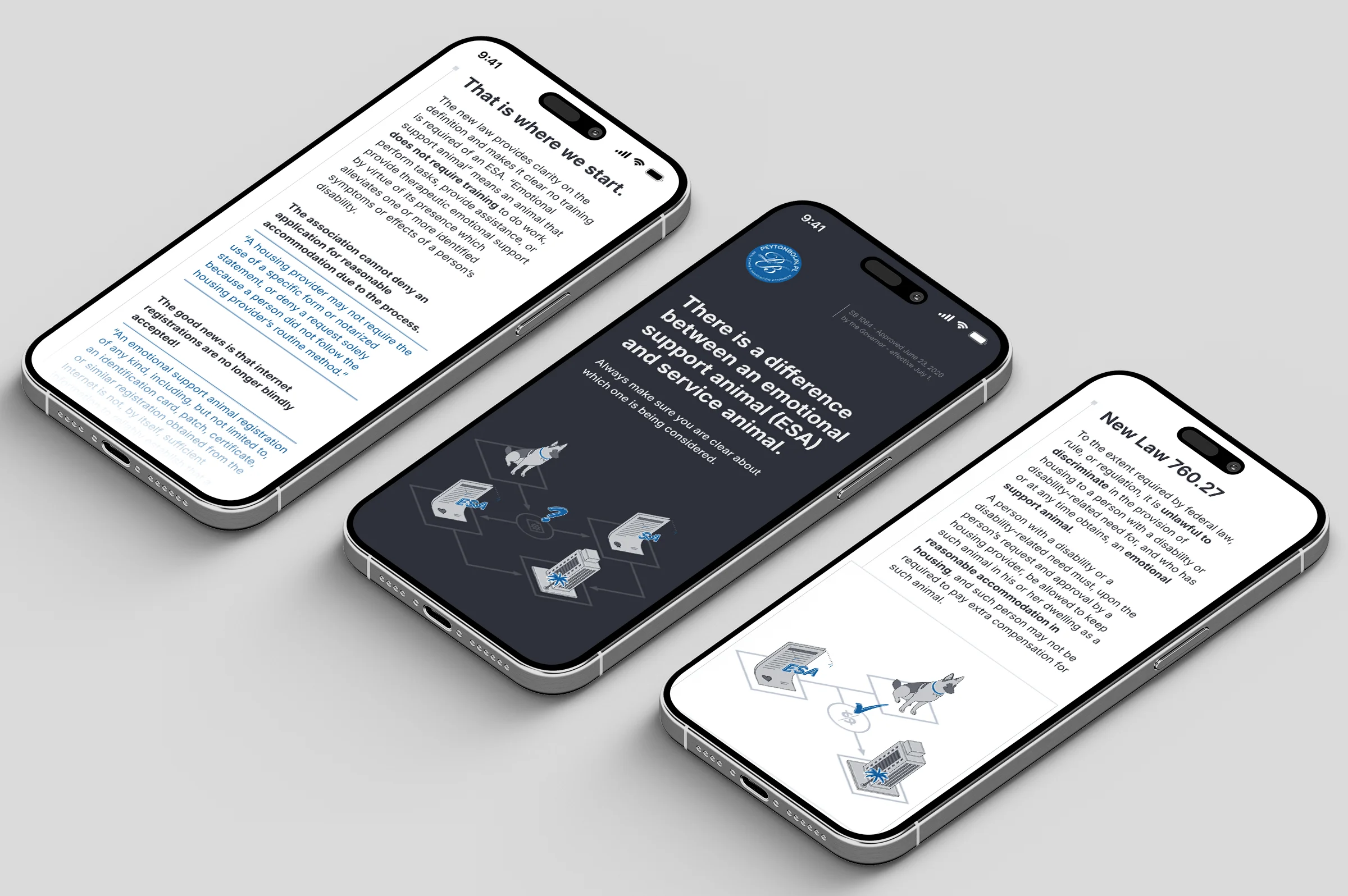
Applied visual design of housing rights information presented in a clear and structured document layout
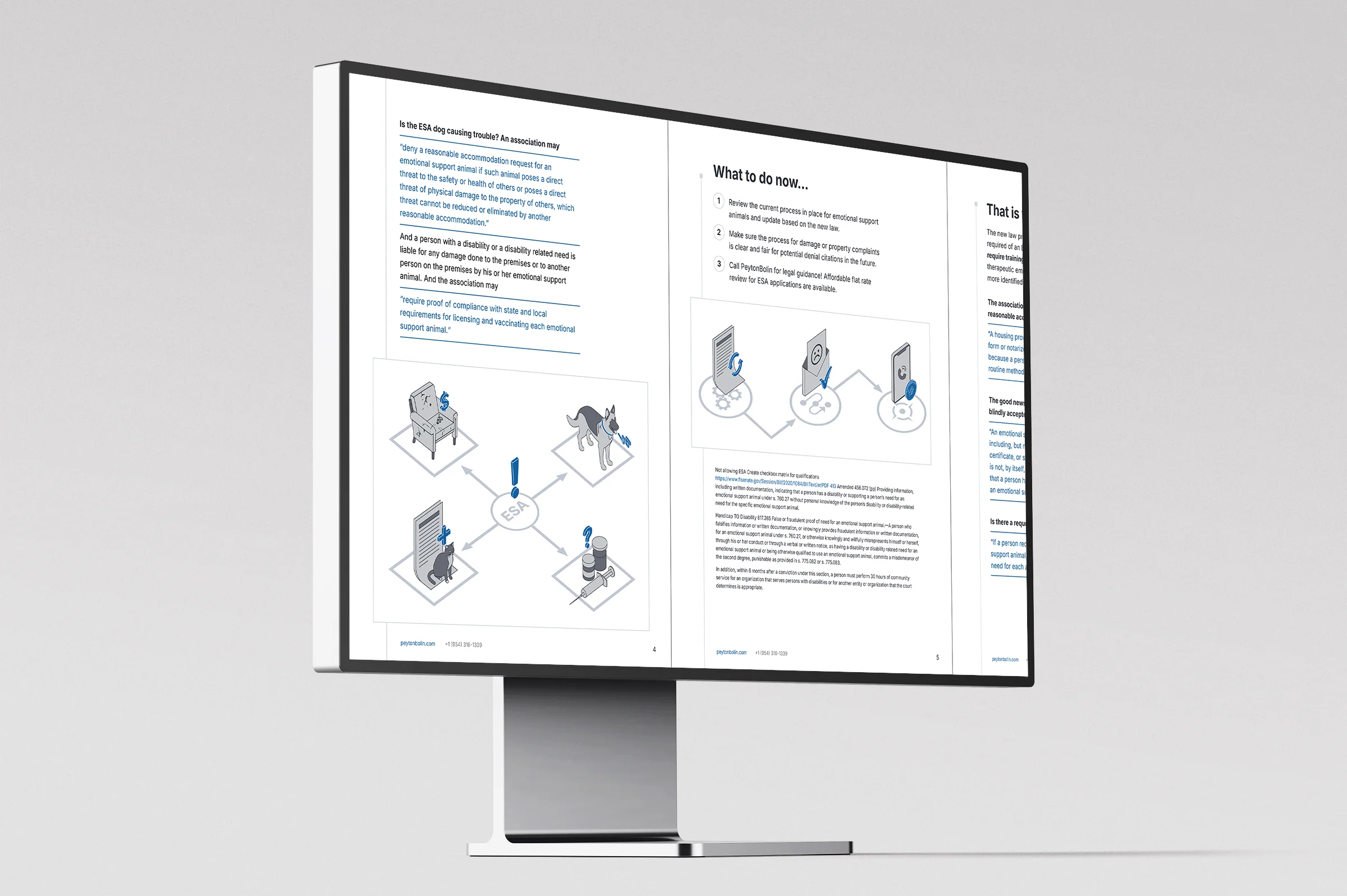
Structured legal information translated into a clean and accessible visual format for end users